Our standards-based, self-declared commitments to quality, transparency and accountability in training and assessment services.
The documents below are self-declarations of conformity — BESA's voluntary commitments to apply the principles and requirements of the referenced international standards in its training and assessment services. They are not third-party accreditation certificates.
Declared: May 14, 2026 · BESA (Öz Beyan) · Ongoing
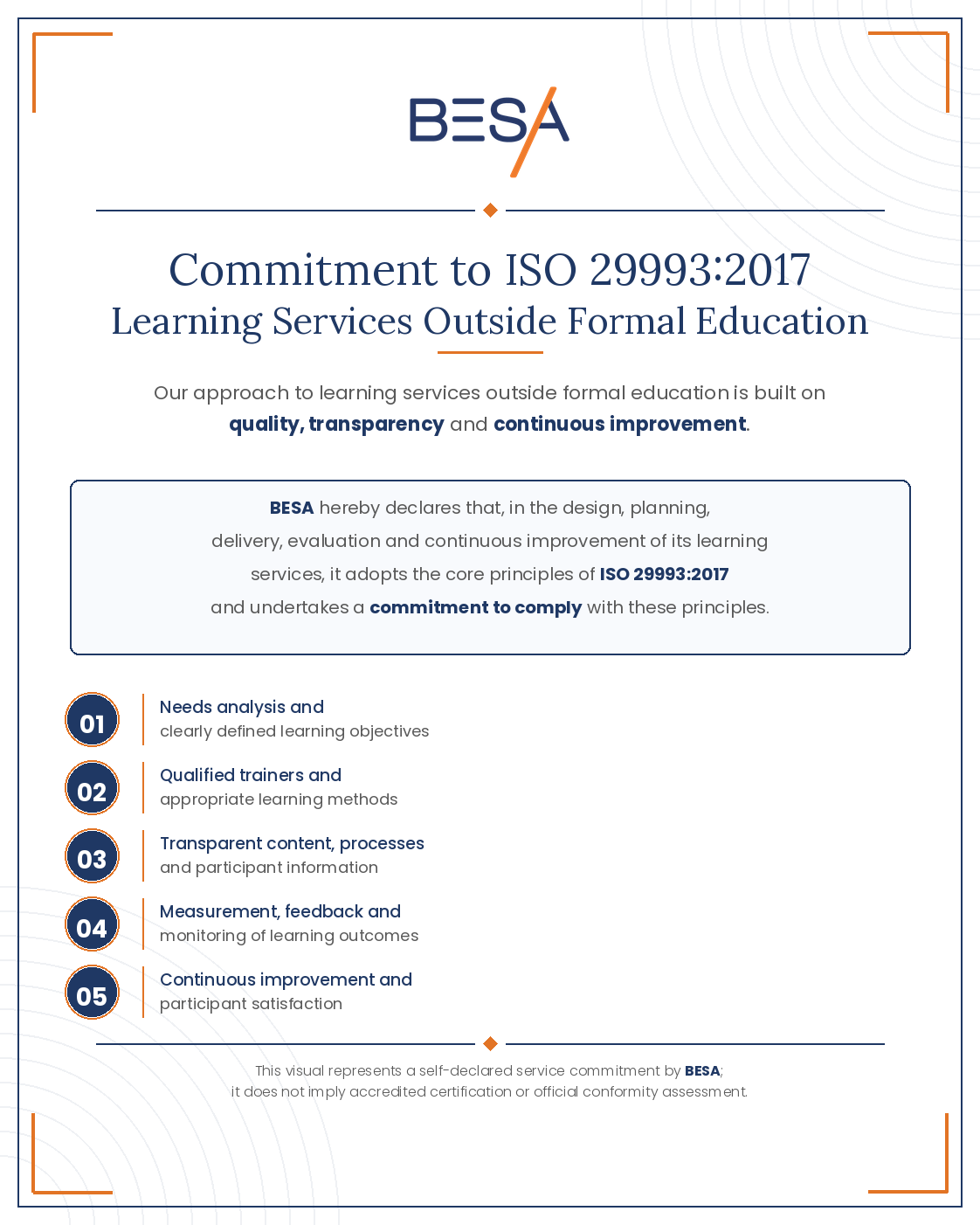
ISO 29993:2017-based learning services approach
BESA applies the core principles of ISO 29993:2017 – Learning services outside formal education in the design, planning, delivery, evaluation and improvement of professional and corporate training services outside formal education.
BESA's goal is not merely to provide training, but to create applicable, measurable and sustainable learning outcomes tailored to the genuine needs of participants and organizations.
BESA is committed to providing clear information to participants or client organizations prior to training on the training topic, scope, duration, methodology, target audience, trainer credentials and expected learning outcomes. Training content is prepared taking into account current regulations, standard requirements, sector practices and good practice examples. In this context, BESA regards transparency and participant communication as one of its core service principles.
BESA aims to work with trainers who are proficient in their subject, have practical application experience, possess strong communication skills and keep up to date with current developments in their field. Trainer selection considers not only theoretical knowledge but also practical field experience, ability to explain through case studies, competency in guiding participants' questions, and capacity to manage the training process effectively.
BESA training programmes support active participant engagement, questioning, discussion, case study evaluation and application-oriented learning. The purpose of training is not merely to convey standard clauses or theoretical information to participants, but to demonstrate how this knowledge can be applied within the organization and to develop the professional competency of participants.
In line with the core principles of ISO 29993:2017 relating to learning services, BESA commits to:
This declaration expresses BESA's own service approach and quality commitment. It does not constitute accredited certification, official conformity assessment or third-party verification.
Self-Declaration Document
Declared: May 14, 2026 · BESA (Öz Beyan) · Ongoing
Competency-Based Training and Measurable People Development
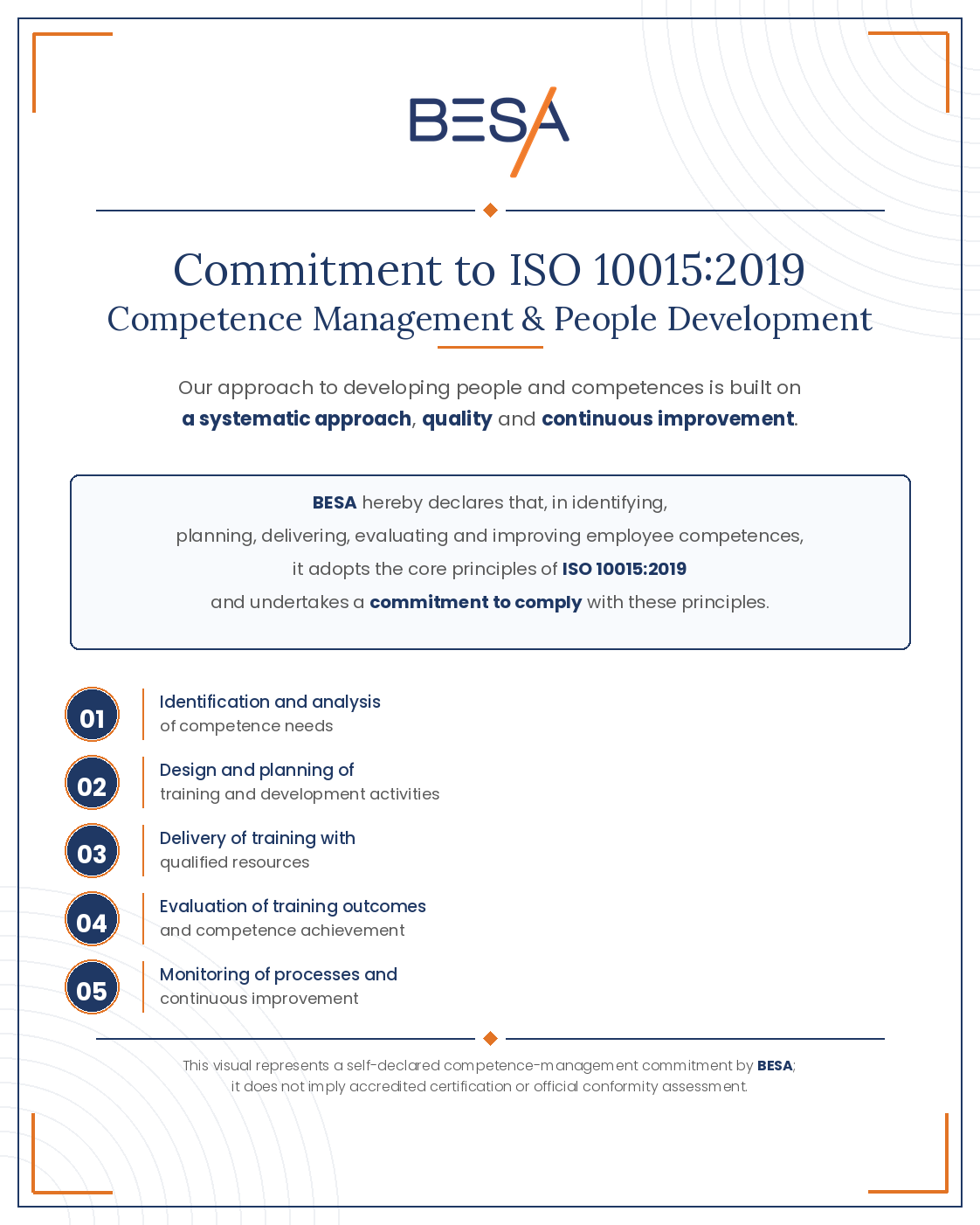
BESA applies the guiding approach of ISO 10015:2019 – Quality management — Guidelines for competence management and people development in identifying training needs, developing competencies, monitoring training effectiveness and contributing to human resource development.
BESA's goal is not merely to provide training, but to contribute to the competency development, quality culture and sustainable learning processes of organizations.
At the beginning of each training process, the expectations, existing knowledge levels, job responsibilities and development needs of participants and organizations are taken into account. Training programmes are planned not merely as general subject delivery, but with due regard to the organization's field of activity, sector structure, regulatory obligations, management system requirements and employee competency needs. This approach is aligned with the competency-based training philosophy of ISO 10015:2019.
For each training delivered by BESA, what knowledge, skills or awareness participants should have by the end of the training is clearly defined. Learning objectives are formulated to be as measurable, clear and applicable as possible, so that the training process is not limited to theoretical knowledge transfer but focuses on practical outcomes that participants can use in their professional lives.
BESA values evaluating participant feedback, the level of achievement of learning outcomes and whether training objectives have been met at the end of training programmes. Where appropriate, short assessments, participant satisfaction forms, knowledge measurement exercises or evaluation interviews with the organization may be used following training. This approach is directly aligned with ISO 10015:2019's principles on monitoring training effectiveness and evaluating competency development.
BESA does not regard training services as a fixed and unchanging structure. Training content and methods are regularly reviewed in light of participant feedback, customer expectations, regulatory changes, standard revisions and sector developments. In this context, BESA regards continuous improvement as one of its core quality principles in training services.
In line with ISO 10015:2019's guiding approach to competency management and people development, BESA commits to:
This declaration expresses BESA's own service approach and quality commitment. It does not constitute accredited certification, official conformity assessment or third-party verification.
Self-Declaration Document
Declared: May 15, 2026 · BESA (Öz Beyan) · Ongoing
A Standards-Based Transparent Approach to Portfolio and Competency Assessment
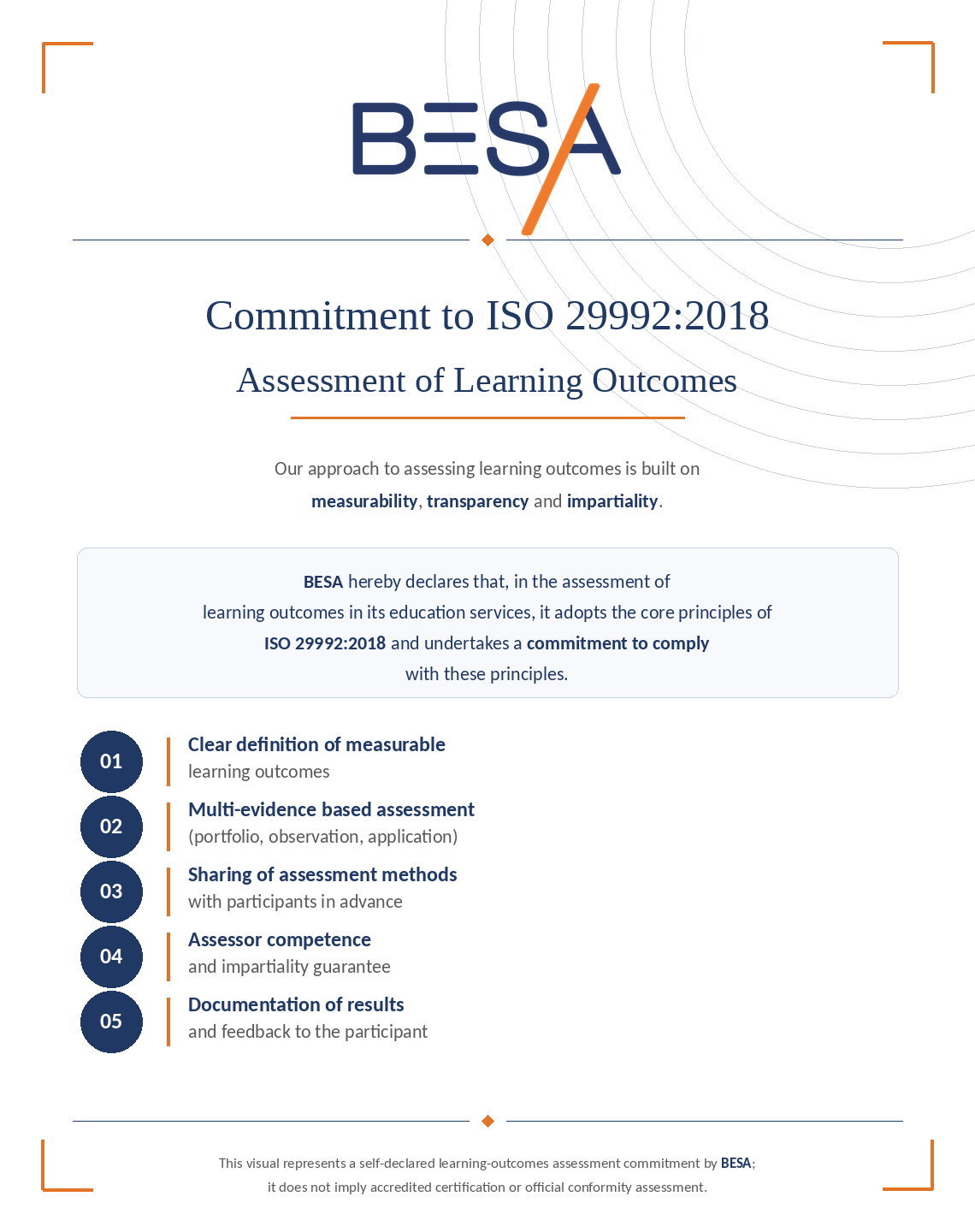
At BESA, we adopt ISO 29992:2018 – Assessment of Learning Outcomes as a guiding framework for our portfolio-based and competency-focused assessment services. This commitment ensures the reliability, consistency and transparency of our assessment processes.
Every assessment process is based on clearly defined, measurable learning outcomes established at the outset of the training or development programme. Participants are informed in advance of what they need to achieve and how they will be assessed.
Rather than relying on a single exam or instantaneous performance, we combine multiple types of evidence — including portfolios, observations, project work, self-assessment and peer assessment. This approach enables a more complete and reliable demonstration of genuine competence.
The assessment criteria, scoring rubrics and decision mechanisms we use are shared with participants in advance. How assessment results will be interpreted and the standards against which competence decisions are made are clearly documented.
Our assessors are trained to make objective, unbiased decisions in accordance with ISO 29992:2018 principles. Where multiple assessors are involved, inter-rater reliability mechanisms are applied to ensure consistency across assessments.
The outputs of each assessment process are documented in writing, and participants receive a comprehensive, development-focused feedback report. Competence decisions are grounded in evidence, criteria and the process assurances required by the standard.
This commitment applies to assessment activities within non-formal learning services conducted by BESA. ISO 29992:2018 is an international guidance standard, not an accreditation certificate, and this declaration is BESA's self-declaration.
Self-Declaration Document
Explore our institutional certificates, or get in touch to discuss how we can support your organisation.